Riffle – Sampler Splitter in Ambala
Get In Touch
Riffle Sampler Splitter in Ambala
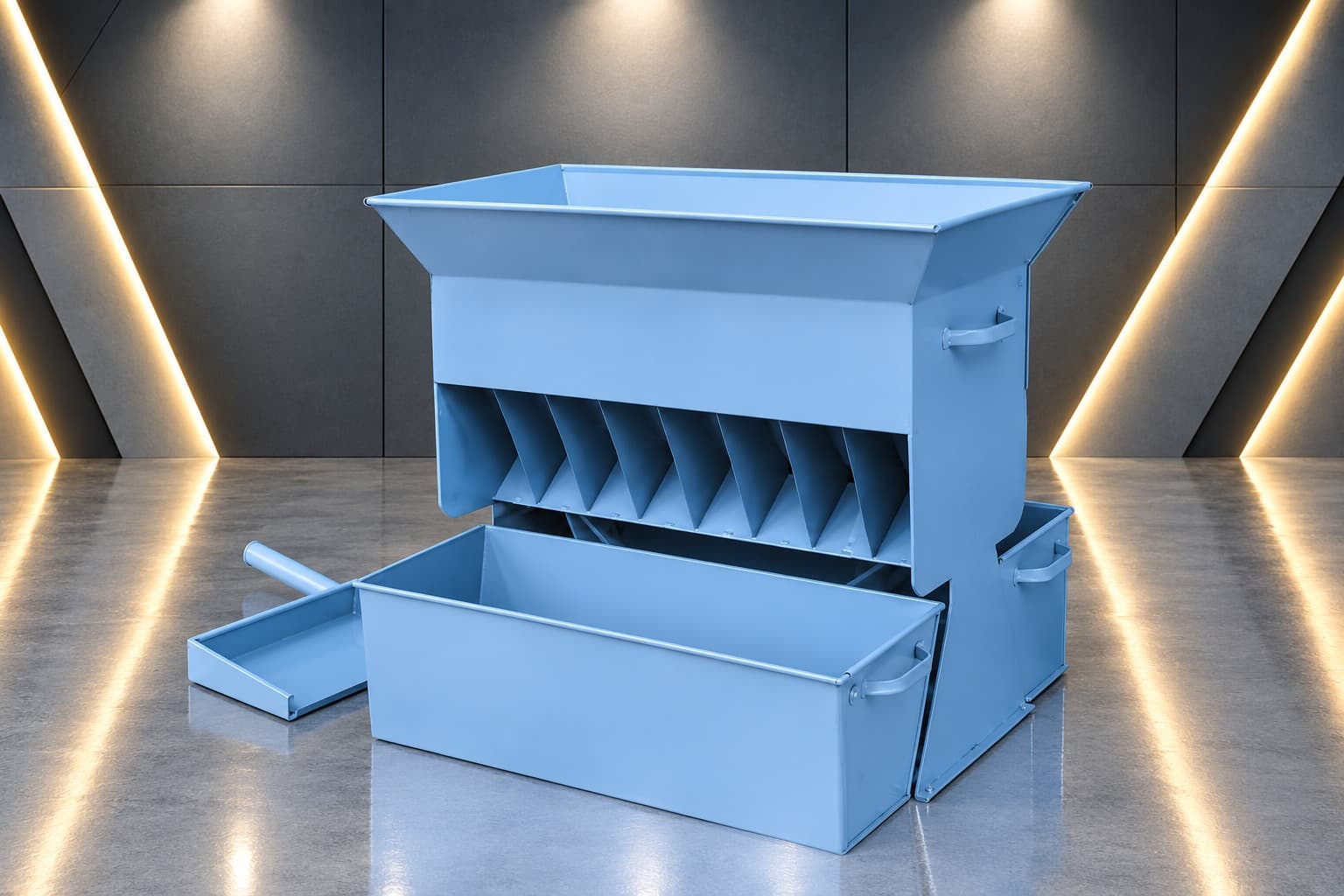
A Riffle Sampler Splitter in Ambala is a laboratory sample-reduction apparatus used to divide bulk aggregates, sand, gravel, soil, and other free-flowing granular materials into smaller, representative portions for testing. The splitter uses a series of equal-width chutes that direct alternate portions into separate collection containers.
Proper sample reduction is important because laboratory test results should represent the original bulk material as closely as practical. ASTM C702/C702M-24 covers procedures for reducing large aggregate samples to an appropriate testing size while minimizing differences between the selected test portion and the original sample.
Riffle Sampler Splitter Manufacturer in Ambala
A Riffle Sampler Splitter Manufacturer in Ambala should provide a splitter selected according to the material type, maximum particle size, required sample quantity, and laboratory application.
When purchasing from a Riffle Sampler Splitter Manufacturer in Ambala, important points include chute opening, hopper arrangement, collection pans, construction, and ease of cleaning. The opening should be appropriate for the largest particles being processed so that material can pass freely without unnecessary blockage or biased separation.
Actual dimensions, chute count, material, and capacity should be confirmed for the selected model.
Riffle Sampler Splitter Supplier in Ambala
A Riffle Sampler Splitter Supplier in Ambala can provide equipment for aggregate, soil, mineral, sand, and other granular-material laboratories.
A good Riffle Sampler Splitter Supplier in Ambala should confirm whether the required splitter is suitable for coarse or fine material and whether the quoted supply includes the feed pan and collection pans. Accessories should always be confirmed in the quotation rather than assumed.
Riffle Sampler Splitter Exporter in Ambala
For international laboratory procurement, a Riffle Sampler Splitter Exporter in Ambala should confirm the required chute configuration, packing, documentation, material specifications, and destination requirements.
A Riffle Sampler Splitter Exporter in Ambala should also identify the actual supplied model and configuration so the purchaser can verify suitability before shipment.
Riffle Sampler Splitter Distributor in Ambala
A Riffle Sampler Splitter Distributor in Ambala can support laboratories that need a practical method for reducing bulk samples before testing.
When comparing a Riffle Sampler Splitter Distributor in Ambala, check the chute opening, number of chutes, hopper design, collection arrangement, construction, and intended particle-size range instead of selecting only on price.
Technical Specifications
| Parameter | Specification / Selection Point |
|---|---|
| Equipment | Riffle Sampler Splitter |
| Main function | Representative sample reduction |
| Typical materials | Aggregate, sand, gravel, soil and granular materials |
| Operating principle | Gravity-fed mechanical splitting |
| Split arrangement | Alternate chutes discharge into separate portions |
| Chute opening | Selected according to maximum particle size |
| Chute count | Model-dependent |
| Hopper capacity | Model-dependent |
| Collection pans | Confirm with selected configuration |
| Construction | Confirm against supplied model |
| Standard reference | ASTM C702/C702M-24, where applicable |
ASTM C702/C702M-24 identifies sample reduction as a means of obtaining a convenient test quantity while minimizing variation between the reduced portion and the larger sample.
Main Features
-
Mechanical method for reducing bulk samples.
-
Produces approximately divided sample portions when correctly operated.
-
Suitable for aggregate and granular-material testing.
-
Multiple chute configurations can be selected for different particle sizes.
-
Gravity-fed operation requires no electrical drive.
-
Separate collection containers simplify sample handling.
-
Useful before sieve analysis and other laboratory tests.
-
Simple operating principle with minimal maintenance requirements.
-
Suitable for routine laboratory sample preparation.
-
Easy access for cleaning between different materials.
-
Actual chute dimensions and accessories are model-dependent.
Applications
A Riffle Sampler Splitter in Ambala is commonly used for:
-
Aggregate sample reduction
-
Sand and gravel testing
-
Soil sample preparation
-
Sieve analysis preparation
-
Construction-material laboratories
-
Mineral and geological sample preparation
-
Quality-control laboratories
-
Research and educational laboratories
The purpose is to obtain a smaller test portion while maintaining a representative relationship with the original sample. ASTM C702/C702M-24 specifically addresses reduction of aggregate samples for testing.
Industries Served
The equipment can be used by aggregate producers, construction-material manufacturers, civil engineering laboratories, geotechnical laboratories, mining and mineral laboratories, research institutions, educational laboratories, and independent testing facilities.
A Riffle Sampler Splitter Manufacturer in Ambala should consider the customer's material characteristics and maximum particle size before recommending a configuration.
Standards and Testing
ASTM C702/C702M-24 is an active ASTM practice covering three methods for reducing large aggregate samples to appropriate testing size. Its purpose is to minimize variation between the selected test sample and the original sample.
The mechanical splitter method is particularly relevant where a representative portion is required from a bulk aggregate sample. ASTM's related training material identifies the sample splitter as the apparatus used for Method A.
The applicable standard should always be confirmed against the material, test method, and selected splitter configuration.
Quality & Product Configuration
Before ordering, confirm:
-
Maximum particle size
-
Required chute opening
-
Number of chutes
-
Hopper capacity
-
Collection-pan arrangement
-
Construction material
-
Laboratory or field application
-
Applicable test method
-
Supplied accessories
Actual product photographs, dimensions, chute sizes, and accessories should be matched with the selected model and quotation.
How to Select the Right Splitter
For a Riffle Sampler Splitter in Ambala, first identify the largest particle in the sample. The chute opening must allow the material to pass freely while providing an appropriate division of the sample. The required sample volume then determines the suitable hopper and collection-pan capacity.
For application-specific requirements, ask the Riffle Sampler Splitter Supplier in Ambala to confirm the appropriate configuration.
Why Choose the Right Equipment?
Selecting the correct Riffle Sampler Splitter Exporter in Ambala or Riffle Sampler Splitter Distributor in Ambala is important because an unsuitable chute opening or poor feeding technique can affect the representativeness of the reduced sample.
Civil Testing Equipment can provide product information and quotation support according to the required application and configuration.
Get a Quote
For pricing, availability, configuration, and accessory details for a Riffle Sampler Splitter in Ambala, contact:
Phone: +91-8826549585
Email: civiltestingequipment@gmail.com
FAQs
1. What is a Riffle Sampler Splitter?
It is a mechanical apparatus used to divide a bulk granular sample into smaller portions for laboratory testing.
2. What materials can be processed?
Common applications include aggregates, sand, gravel, soil, minerals, and other suitable free-flowing granular materials.
3. Which standard covers aggregate sample reduction?
ASTM C702/C702M-24 covers procedures for reducing aggregate samples to testing size.
4. How does a riffle splitter work?
Material is introduced across a series of equal-width chutes. Alternate chutes direct material into separate collection containers, producing divided sample portions.
5. How should chute size be selected?
The chute opening should be selected according to the maximum particle size and the applicable testing procedure. The material must be able to pass freely through the splitter.
6. Does a riffle splitter require electricity?
No. A conventional riffle splitter operates mechanically by gravity and does not require an electrical drive.
7. Are collection pans included?
This depends on the selected model. The included pans and other accessories should be confirmed in the quotation.
8. Can it be used before sieve analysis?
Yes. Sample splitters are commonly used to reduce bulk aggregate or granular samples to a manageable laboratory quantity before subsequent testing.