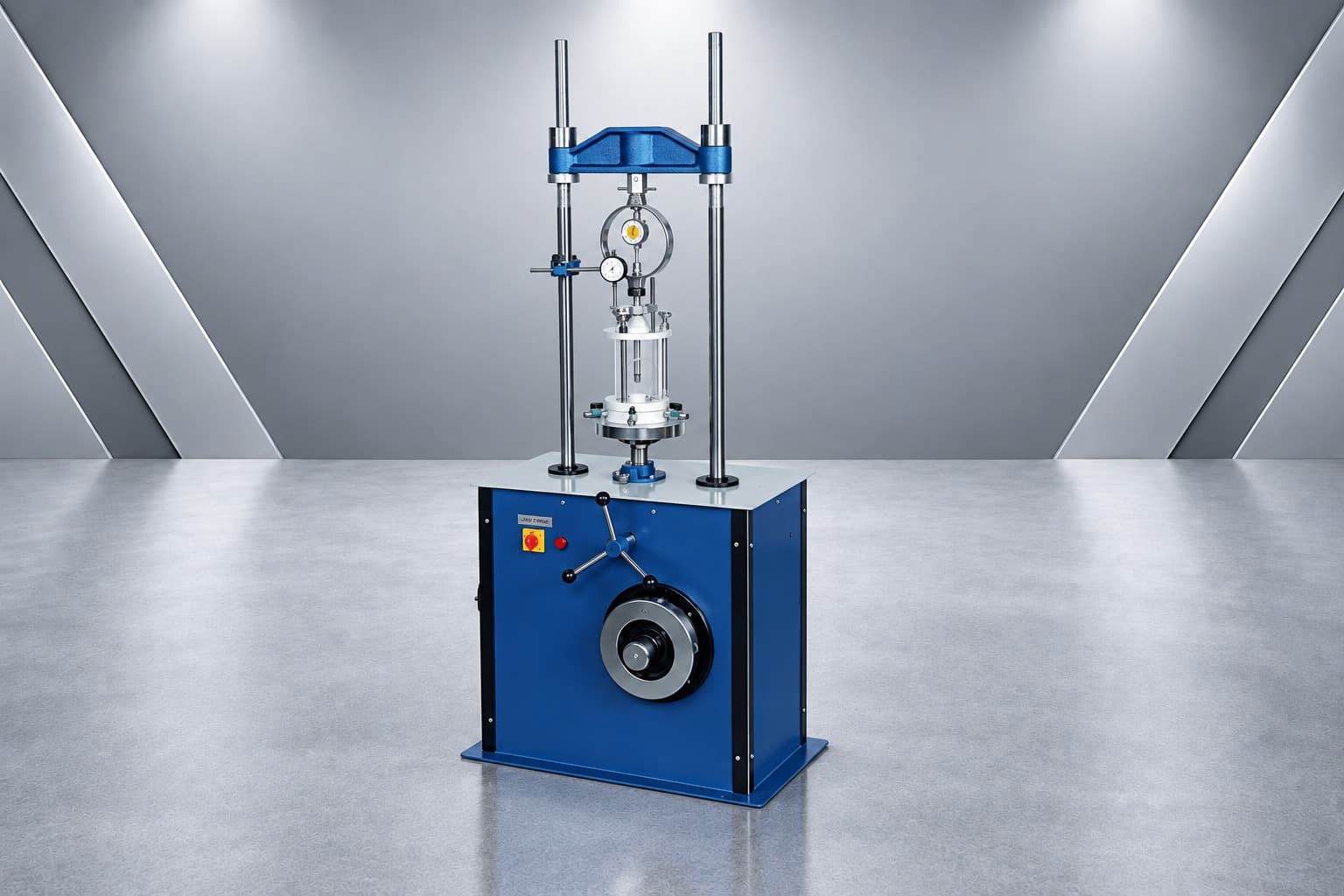
TRIAXIAL SHEAR TEST APPARATUS in Jalandhar
Get In Touch
Triaxial Shear Test Apparatus in Jalandhar
Product Overview
The Triaxial Shear Test Apparatus in Jalandhar is used in geotechnical laboratories to evaluate the shear strength and stress-strain behaviour of soil under controlled laboratory conditions. It is an important testing system for civil engineering colleges, soil investigation laboratories, geotechnical consultants, and construction testing facilities.
The triaxial test involves placing a cylindrical soil specimen inside a membrane and triaxial cell. Confining pressure is applied around the specimen, followed by axial loading until the soil reaches failure or the required testing endpoint. Measurements taken during the test help engineers evaluate soil strength and deformation characteristics.
Engineering Solutions Equipment caters to the laboratory testing equipment segment. When selecting a Triaxial Shear Test Apparatus in Jalandhar, buyers should confirm the required test type, measurement arrangement, specimen dimensions, and configuration against their laboratory's testing requirements.
Working Principle of Triaxial Shear Testing
The triaxial shear test is based on applying controlled confining pressure and axial stress to a soil specimen. The specimen is generally enclosed in a rubber membrane and placed inside a pressure cell. Pressure acts around the specimen, while an axial load is applied vertically.
During the test, the applied load, deformation, and relevant pressure readings are recorded. Depending on the configuration, pore-water pressure and volume changes may also be measured. The resulting data can be used to assess soil shear strength, stress-strain response, cohesion, and angle of internal friction, where appropriate to the test procedure.
Unlike some simpler shear tests, triaxial testing allows drainage conditions to be controlled for different test procedures. The selected method determines how the specimen is consolidated, drained, and sheared. Correct sample preparation and testing procedures are essential for meaningful results.
Types of Triaxial Shear Tests
Before purchasing a Triaxial Shear Test Apparatus in Jalandhar, laboratories should identify which testing procedures they need to perform.
1. Unconsolidated Undrained (UU) Test
In a UU test, the specimen is not allowed to consolidate under the applied confining pressure before shearing, and drainage is prevented during the test. This method is commonly used to assess undrained shear strength under the specified testing conditions.
2. Consolidated Undrained (CU) Test
In a CU test, the specimen is first consolidated under confining pressure and then sheared without drainage. Depending on the system configuration, pore-water pressure may also be measured to support the determination of relevant strength parameters.
3. Consolidated Drained (CD) Test
In a CD test, the specimen is consolidated and sheared under drained conditions. The shearing rate must allow drainage in accordance with the applicable procedure. This test can help determine effective-stress strength parameters.
The equipment configuration and measurement requirements can differ between these methods. Laboratories should verify that the selected apparatus includes the necessary facilities for their intended tests.
Applications in Civil and Geotechnical Engineering
A Triaxial Shear Test Apparatus in Jalandhar can support several laboratory and engineering applications when used with suitable specimens and procedures.
-
Soil mechanics laboratories: Used to evaluate soil strength and deformation behaviour.
-
Geotechnical investigations: Provides laboratory data for assessing subsurface soil properties.
-
Foundation engineering: Soil strength parameters may contribute to foundation design calculations.
-
Slope stability studies: Test results can support the evaluation of soil resistance under relevant stress conditions.
-
Road and embankment projects: Helps characterise soil materials used in earthworks.
-
Academic institutions: Supports practical experiments and demonstrations in soil mechanics.
-
Research laboratories: Enables controlled studies of soil response under different stress and drainage conditions.
Test results should be interpreted with the relevant site investigation data, soil classification, sample quality, and engineering design requirements.
Important Features to Check Before Buying
When comparing a Triaxial Shear Test Apparatus Supplier in Jalandhar, consider the following technical and practical factors before selecting a product.
Triaxial cell: Confirm the cell configuration and the specimen dimensions supported by the specific model.
Loading system: Check the method of axial loading and how load and deformation are measured.
Pressure control: Verify the available confining-pressure arrangement and whether it suits the intended test procedures.
Drainage and pore-pressure facilities: For tests requiring drainage control or pore-pressure measurement, confirm the required valves, connections, and measurement components are included.
Volume-change measurement: Determine whether the selected configuration supports volume-change measurements where required.
Accessories and documentation: Request a written list of included components, operating instructions, model specifications, and applicable technical documents.
Do not assume every triaxial apparatus has the same pressure range, load capacity, automation, or accessories. These details should be confirmed for the exact model before purchase.
Standards and Testing Considerations
The relevant test standard depends on the type of triaxial test being performed. In India, IS 2720 (Part 11) covers the determination of soil shear-strength parameters from an unconsolidated-undrained triaxial compression test without pore-water pressure measurement. IS 2720 (Part 12) addresses consolidated-undrained triaxial compression with pore-water pressure measurement.
Laboratories should check the applicable edition and the exact requirements of the test they intend to conduct. The apparatus configuration, specimen preparation, loading procedure, drainage conditions, and recording of readings should follow the relevant method.
A Triaxial Shear Test Apparatus Manufacturer in Jalandhar should be evaluated on the basis of verified product specifications and the equipment's suitability for the intended procedure, not on general product descriptions alone.
Choosing the Right Apparatus for Your Laboratory
Selecting suitable equipment starts with identifying your testing needs. A teaching laboratory may prioritise routine educational experiments, while a geotechnical testing facility may require additional pressure measurement, drainage control, or data recording capabilities.
Buyers searching for a Triaxial Shear Test Apparatus Distributor in Jalandhar should verify the product configuration, supply terms, available technical support, and the seller's actual distribution role where applicable.
Engineering Solutions Equipment can be contacted to discuss product requirements and request available technical information. Before placing an order, confirm the model, included components, applicable testing procedures, delivery terms, and any warranty or support arrangements offered.
For export-related procurement, buyers should verify the seller's export capability, shipping arrangements, documentation, and destination-country requirements rather than assuming these services are automatically available.
Contact Details
Engineering Solutions Equipment Address: F-218, Vishnu Garden, Jalandhar – 110018
Phone: +91-8826549585
Email: civiltestingequipment@gmail.com
Frequently Asked Questions
1. What is a triaxial shear test apparatus used for?
A triaxial shear test apparatus is used to evaluate soil shear strength and stress-strain behaviour under controlled confining pressure and axial loading. It can support the determination of relevant strength parameters according to the selected test method.
2. What is the difference between UU, CU, and CD tests?
UU stands for unconsolidated undrained, CU for consolidated undrained, and CD for consolidated drained. The methods differ in their consolidation and drainage conditions during testing. The appropriate method depends on the testing objective and the relevant standard.
3. Which standards are relevant to triaxial soil testing?
IS 2720 (Part 11) is relevant to the specified unconsolidated-undrained test without pore-pressure measurement, while IS 2720 (Part 12) covers consolidated-undrained testing with pore-pressure measurement. Laboratories should verify the applicable edition and test requirements.
4. What should I check when selecting a supplier?
When evaluating a Triaxial Shear Test Apparatus Supplier in Jalandhar, request the exact model specification, supported specimen dimensions, loading and pressure arrangements, included components, and relevant documentation before purchasing.
5. What should buyers verify before choosing an exporter?
A Triaxial Shear Test Apparatus Exporter in Jalandhar should be evaluated based on verified export capability, shipping arrangements, export documentation, packaging, and destination-specific requirements. Confirm these details directly before ordering.
6. Can this equipment be used for educational and research laboratories?
Yes. Triaxial testing equipment can support soil mechanics teaching, laboratory experiments, and geotechnical research. The selected model must have the configuration and measurement facilities required for the intended procedures.