BITUMEN TESTING in Kalyan-Dombivli
Get In Touch
Bitumen Testing Equipment Manufacturer & Supplier in Kalyan-Dombivli
Bitumen testing is an essential part of quality control for road construction, asphalt production, pavement engineering, and bituminous material research. Different laboratory tests are performed to evaluate the physical and performance characteristics of bitumen, including penetration, ductility, softening point, flash point, fire point, specific gravity, viscosity, and stability-related properties.
Our range of Bitumen Testing Equipment is designed for laboratories, highway projects, asphalt plants, construction companies, educational institutions, research facilities, and quality-control departments. The equipment used for bitumen testing helps engineers and laboratory professionals evaluate material properties under controlled testing conditions and maintain consistency between test samples.
For projects requiring reliable laboratory infrastructure, Bitumen Testing Equipment in Kalyan-Dombivli can be selected according to the type of bitumen, applicable testing method, sample volume, accuracy requirements, and project specifications. Proper equipment selection is important because different tests require different heating systems, moulds, measuring arrangements, temperature controls, and loading mechanisms.
What Is Bitumen Testing Equipment?
Bitumen Testing Equipment refers to laboratory instruments and apparatus used to determine the physical, thermal, mechanical, and performance-related properties of bituminous binders and asphalt mixtures.
Typical laboratory testing may include:
-
Penetration testing
-
Ductility testing
-
Softening point testing
-
Flash and fire point testing
-
Specific gravity testing
-
Viscosity testing
-
Bitumen extraction
-
Marshall stability and flow testing
-
Asphalt mixture compaction
-
Temperature-controlled laboratory testing
The results help laboratories assess whether a bituminous material is suitable for a particular pavement, road construction, or asphalt application.
Types of Bitumen Testing Equipment
A laboratory may require several instruments depending on its testing scope. Common equipment includes:
Bitumen Penetrometer
A bitumen penetrometer measures the penetration of a bituminous material under specified loading, temperature, and time conditions. The result is used to characterize the consistency or hardness of the binder.
Bitumen Ductility Testing Machine
A ductility testing machine evaluates the distance a standard bitumen specimen can elongate before breaking under controlled conditions. Temperature control and uniform pulling speed are important factors during the test.
Softening Point Apparatus
The Ring and Ball method is commonly used to determine the temperature at which bituminous material reaches a specified softening condition. A controlled heating arrangement and suitable test assembly are required for repeatable results.
Flash and Fire Point Apparatus
Flash point and fire point testing evaluates the temperature characteristics of bituminous materials when exposed to controlled heating and an ignition source. These tests are particularly relevant to material handling and laboratory safety assessment.
Specific Gravity Apparatus
Specific gravity testing determines the relative density of bituminous material compared with water under specified conditions. The result can support material characterization and asphalt mixture calculations.
Bitumen Extraction Apparatus
Bitumen extraction equipment is used to separate bituminous binder from aggregate in asphalt mixtures. This helps laboratories determine binder-related characteristics and analyze asphalt samples.
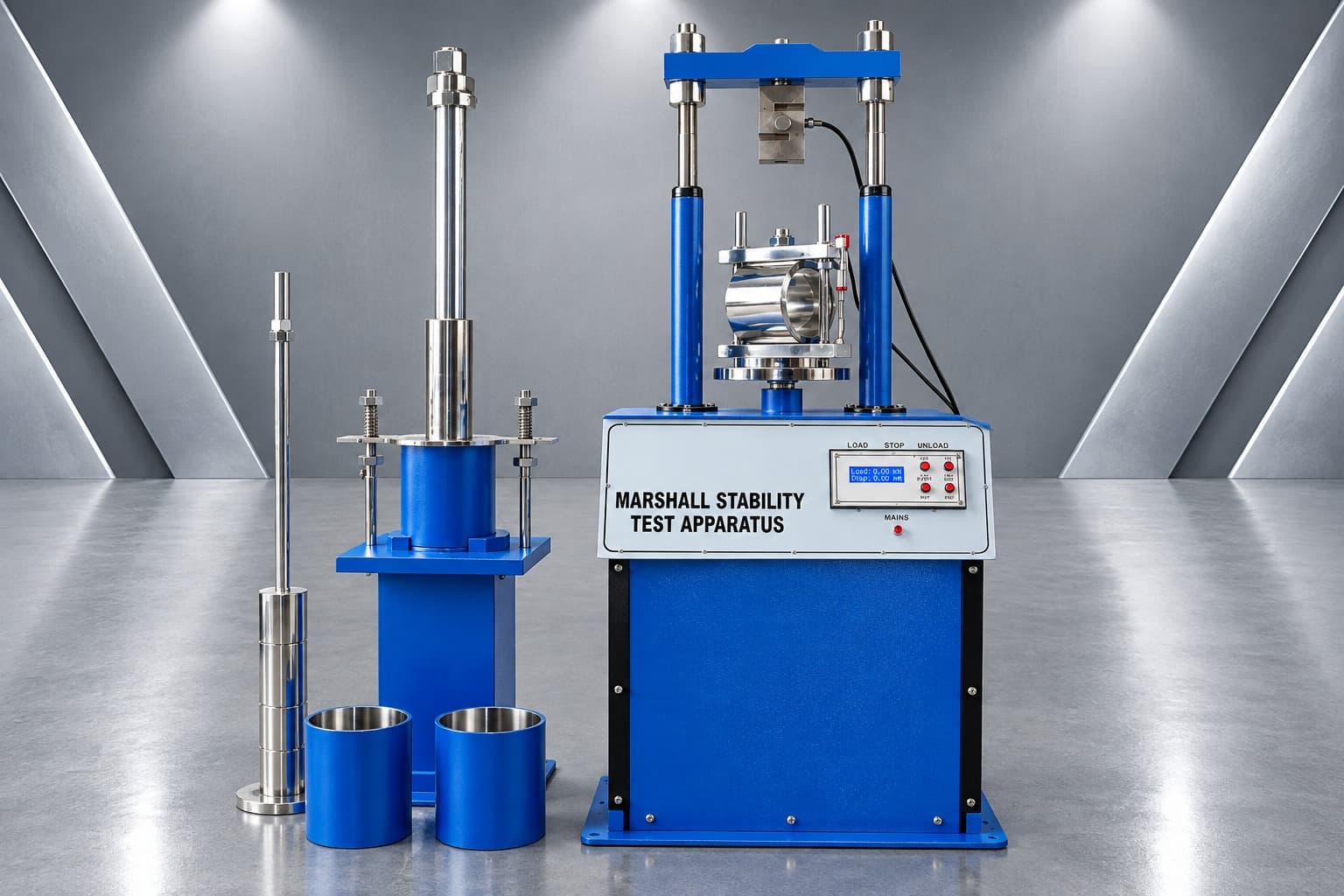
Marshall Stability Testing Equipment
Marshall testing equipment is used for evaluating asphalt mixture stability and flow characteristics. It is commonly associated with pavement mix design and laboratory quality-control work.
Bitumen Laboratory Bath
A temperature-controlled bath can be used where samples need to be maintained at a specified temperature during testing. Stable temperature control is important for tests where material properties are temperature-sensitive.
Bitumen Testing Equipment Manufacturer in Kalyan-Dombivli
Choosing a Bitumen Testing Equipment Manufacturer in Kalyan-Dombivli allows laboratories and project organizations to source equipment according to their required testing applications. Manufacturing considerations include equipment construction, dimensional accuracy, heating arrangements, temperature control, loading mechanism, measuring systems, and compatibility with the intended test method.
For laboratory procurement, buyers should evaluate:
-
Test method and applicable specification
-
Required measurement range
-
Temperature-control requirements
-
Sample dimensions and capacity
-
Mechanical loading arrangement
-
Material of construction
-
Instrument readability
-
Calibration requirements
-
Availability of accessories and replacement components
-
Installation and after-sales support
A technically suitable equipment configuration is more important than selecting an instrument only on price.
Bitumen Testing Equipment Supplier in Kalyan-Dombivli
A Bitumen Testing Equipment Supplier in Kalyan-Dombivli can provide individual apparatus as well as complete laboratory equipment requirements. This is useful for laboratories setting up new testing facilities or upgrading existing pavement and asphalt testing sections.
A supplier may provide combinations of penetration, ductility, softening point, flash and fire point, extraction, specific gravity, and Marshall testing equipment based on the laboratory's testing scope.
Before placing an order, buyers should confirm:
-
Equipment specifications
-
Test capacity
-
Temperature range
-
Electrical requirements
-
Accessories supplied
-
Applicable testing procedure
-
Calibration documentation requirements
-
Packaging and transportation
-
Installation requirements
-
Availability of technical support
Bitumen Testing Equipment Exporter in Kalyan-Dombivli
For international laboratory projects, an Bitumen Testing Equipment Exporter in Kalyan-Dombivli can support equipment supply for overseas construction companies, testing laboratories, universities, road authorities, and infrastructure projects.
Export-oriented equipment procurement generally requires attention to product specifications, packaging, documentation, electrical configuration, shipping requirements, and destination-country requirements.
International buyers should provide the required test standards, equipment configuration, quantity, destination, and technical specifications before requesting a commercial quotation.
Bitumen Testing Equipment Distributor in Kalyan-Dombivli
A Bitumen Testing Equipment Distributor in Kalyan-Dombivli can help laboratories source commonly required testing instruments and accessories from a centralized supply channel.
Distribution requirements may vary according to whether the buyer needs a single apparatus, replacement components, or a complete asphalt and bitumen testing laboratory setup.
For recurring procurement, buyers should also consider equipment availability, spare parts, serviceability, lead time, and technical documentation.
How to Select Bitumen Testing Equipment
The correct equipment should be selected according to the actual testing requirement rather than simply choosing the largest or most advanced model.
1. Identify the Required Test
First determine whether the laboratory needs penetration, ductility, softening point, flash point, extraction, specific gravity, viscosity, or asphalt mixture testing.
2. Check the Applicable Standard
Testing should follow the method specified by the project, laboratory, client, or relevant regulatory authority. Equipment configuration should be compatible with that method.
3. Evaluate Temperature Control
Many bitumen tests are highly temperature-dependent. Heating systems, temperature controllers, baths, and sensors should therefore provide appropriate control for the intended test.
4. Consider Measurement Accuracy
The resolution and measurement range should be appropriate for the required test. Mechanical components should also provide consistent movement and loading where applicable.
5. Check Laboratory Capacity
High-volume laboratories may require equipment with greater sample capacity or faster testing workflows, while smaller laboratories may prefer compact configurations.
6. Verify Accessories
Moulds, thermometers, containers, penetration needles, heating arrangements, weights, gauges, and other accessories can affect the usability of the complete testing setup.
Common Applications
Bitumen Testing Equipment in Kalyan-Dombivli is used across several sectors where bituminous materials and asphalt mixtures require laboratory evaluation.
Common applications include:
-
Highway construction projects
-
Road development laboratories
-
Asphalt mixing plants
-
Pavement testing laboratories
-
Infrastructure projects
-
Civil engineering laboratories
-
Quality-control departments
-
Research and development facilities
-
Universities and technical institutes
-
Government and private testing laboratories
-
Asphalt mix design laboratories
The same laboratory may use multiple testing methods because bitumen performance cannot normally be characterized through a single test.
Industries Using Bitumen Testing Equipment
The major industries and organizations using these laboratory instruments include:
-
Road construction
-
Highway infrastructure
-
Civil engineering
-
Asphalt manufacturing
-
Pavement engineering
-
Infrastructure development
-
Construction material testing
-
Academic research
-
Government testing facilities
-
Industrial quality control
Quality and Testing Considerations
Reliable laboratory results depend on more than the instrument itself. Sample preparation, test temperature, loading conditions, operator procedure, equipment calibration, and environmental conditions can all influence the final measurement.
When purchasing Bitumen Testing Equipment, laboratories should therefore consider equipment construction and repeatability alongside documentation and calibration requirements.
Important quality considerations include:
-
Stable temperature control
-
Accurate measuring mechanisms
-
Robust laboratory construction
-
Proper sample fixtures
-
Repeatable operating conditions
-
Appropriate measurement resolution
-
Calibration compatibility
-
Easy maintenance
-
Availability of replacement parts
-
Compliance with the specified test method
Applicable IS, ASTM, EN, or AASHTO methods may differ depending on the material, project, and testing requirement. The exact standard should always be confirmed before equipment selection.
Why Choose the Right Bitumen Testing Equipment?
Bitumen properties change with temperature, composition, ageing, and test conditions. Using equipment that is appropriate for the specified testing method helps laboratories establish consistent test conditions and generate useful comparative data.
A properly planned laboratory setup can also:
-
Reduce unnecessary equipment purchases
-
Improve testing workflow
-
Support repeatable measurements
-
Simplify sample handling
-
Improve laboratory organization
-
Support quality-control procedures
-
Make future laboratory expansion easier
For this reason, equipment selection should begin with the laboratory's testing requirements and expected workload.
Request a Bitumen Testing Equipment Quote
If you are setting up, expanding, or upgrading a bitumen and asphalt testing laboratory, share your required tests, equipment quantities, technical specifications, and delivery requirements.
The equipment requirement can then be evaluated according to the intended application, test procedure, laboratory capacity, and project specifications.
Contact us for a quotation for Bitumen Testing Equipment in Kalyan-Dombivli and discuss the appropriate laboratory configuration for your testing requirements.
Frequently Asked Questions
What is Bitumen Testing Equipment used for?
It is used to evaluate properties of bitumen and asphalt materials through tests such as penetration, ductility, softening point, flash point, specific gravity, extraction, and Marshall stability.
Which equipment is commonly required in a bitumen laboratory?
Common equipment includes a bitumen penetrometer, ductility testing machine, softening point apparatus, flash and fire point apparatus, specific gravity apparatus, extraction equipment, and Marshall testing equipment.
How do I select the right equipment?
Selection depends on the required test methods, material type, sample capacity, temperature requirements, measurement range, applicable standards, and laboratory workload.
Is temperature control important for bitumen testing?
Yes. Many bituminous material properties are temperature-sensitive, so maintaining the specified test temperature is an important part of obtaining consistent laboratory results.
Can bitumen testing equipment be used for asphalt testing?
Certain equipment is specifically designed for bitumen binder testing, while other equipment is designed for asphalt mixture testing. The required instruments should therefore be selected according to the specific test.
What standards should be considered?
The applicable IS, ASTM, EN, or AASHTO testing method should be confirmed according to the project or laboratory requirement before selecting equipment.