GILLMORE NEEDLE APPARATUS in Ludhiana
Get In Touch
Gillmore Needle Apparatus Manufacturer & Supplier in Ludhiana
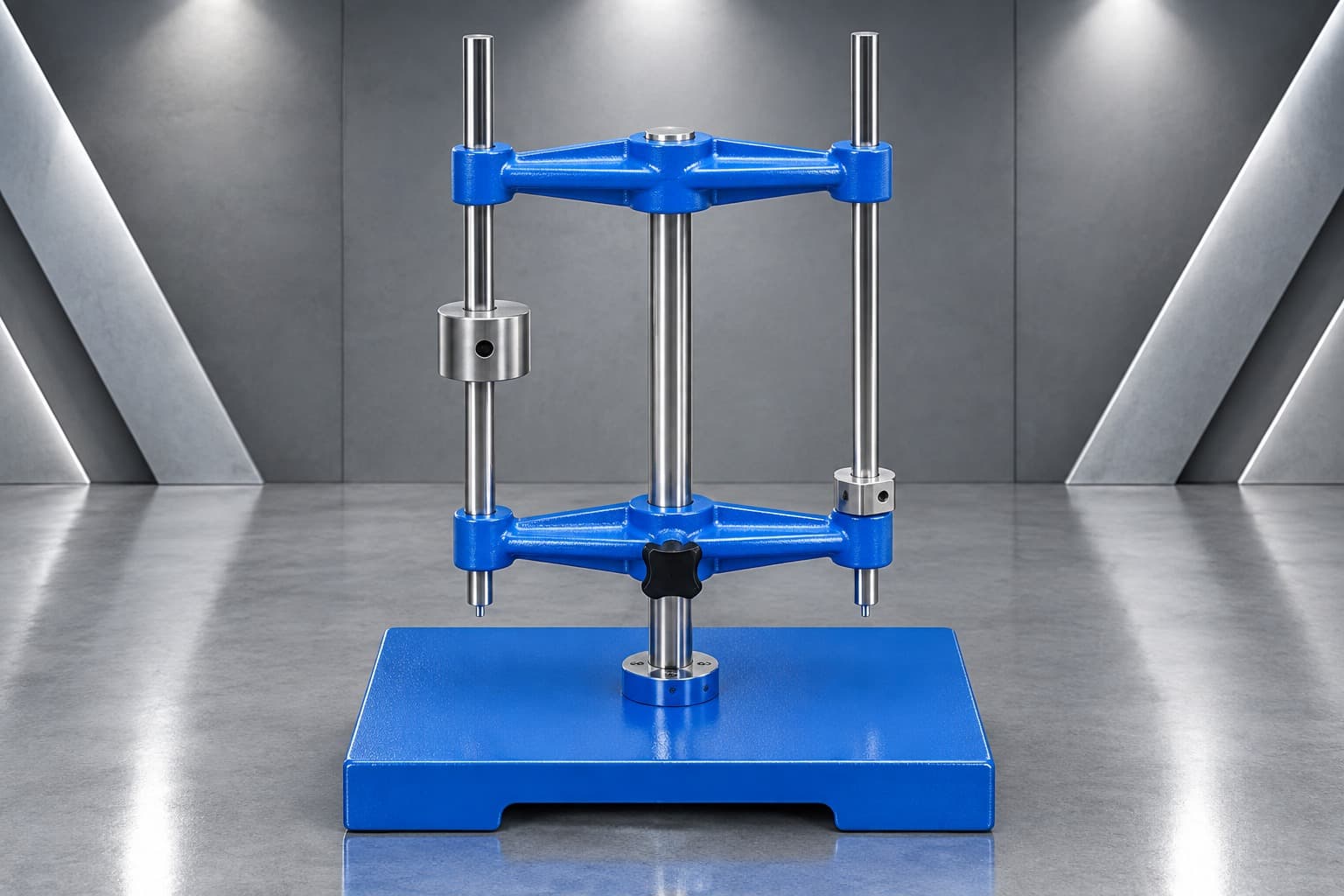
Gillmore Needle Apparatus in Ludhiana is a laboratory testing instrument used to determine the initial and final setting time of hydraulic-cement paste by means of two weighted needles. The apparatus provides a controlled penetration-based method for evaluating the setting behaviour of cement and is used in cement, concrete and civil engineering testing laboratories. ASTM C266 specifically covers determination of the setting time of hydraulic-cement paste using Gillmore needles.
A Gillmore Needle Apparatus in Ludhiana generally consists of a rigid support frame, two independently operated needle assemblies and a stable specimen-supporting base. The initial-setting needle and final-setting needle have different masses and tip diameters, allowing the laboratory technician to determine the progression of cement paste from its initial setting stage to final setting. The apparatus is particularly relevant where the Gillmore method is specified by the applicable testing procedure or project requirement.
For laboratories searching for a Gillmore Needle Apparatus Manufacturer in Ludhiana, the important purchasing factors include needle dimensions and mass, frame stability, dimensional accuracy, specimen support, workmanship and conformity with the applicable testing standard.
Gillmore Needle Apparatus Manufacturer in Ludhiana
A Gillmore Needle Apparatus Manufacturer in Ludhiana should manufacture and assemble the equipment around the dimensional and functional requirements of the selected testing standard. The apparatus requires a stable mechanical frame so that the needles can be positioned vertically and applied consistently to the cement-paste specimen.
The apparatus uses two separate needle systems:
-
Initial-setting needle: 113.4 ± 0.5 g mass with a 2.12 ± 0.05 mm tip diameter
-
Final-setting needle: 453.6 ± 0.5 g mass with a 1.06 ± 0.05 mm tip diameter
-
Needle tips are cylindrical for the specified length and have plane ends positioned perpendicular to the needle axis.
Manufacturing involves fabrication of the support structure, preparation and finishing of the needle assemblies, installation of adjustable arms, mounting of the specimen-supporting plate and dimensional inspection. The final apparatus should be checked against the requirements applicable to the intended test method.
Gillmore Needle Apparatus Supplier in Ludhiana
A Gillmore Needle Apparatus Supplier in Ludhiana can supply the apparatus to cement-testing laboratories, construction-material laboratories, educational institutions, research facilities and quality-control departments.
Before placing an order, buyers should specify:
-
Required testing standard
-
Number of apparatus sets
-
Needle configuration
-
Required material and finish
-
Laboratory application
-
Inspection/documentation requirements
-
Quantity and delivery location
A Gillmore Needle Apparatus Supplier in Ludhiana can also help buyers match the apparatus configuration with their laboratory testing procedure instead of selecting equipment solely on appearance or price.
Gillmore Needle Apparatus Exporter in Ludhiana
A Gillmore Needle Apparatus Exporter in Ludhiana can support international laboratory-equipment requirements where the product specification and applicable testing standard have been defined by the purchaser. Export supply may include protective packaging, product identification, packing documentation and other commercial documents according to the order.
For international procurement, buyers should confirm the applicable standard, required needle tolerances, documentation, packaging requirements and destination-specific shipping instructions before dispatch.
Gillmore Needle Apparatus Specifications
The following parameters are based on the requirements specified for Gillmore needles in ASTM C266.
|
Parameter |
Specification |
|
Product |
Gillmore Needle Apparatus |
|
Primary Application |
Determination of cement-paste setting time |
|
Applicable Standard |
ASTM C266 |
|
Initial Needle Mass |
113.4 ± 0.5 g |
|
Initial Needle Tip Diameter |
2.12 ± 0.05 mm |
|
Final Needle Mass |
453.6 ± 0.5 g |
|
Final Needle Tip Diameter |
1.06 ± 0.05 mm |
|
Needle Tip Length |
4.8 ± 0.5 mm cylindrical portion |
|
Needle End |
Plane and perpendicular to needle axis |
|
Support |
Rigid mechanical frame |
|
Specimen Support |
Plane, non-absorptive plate |
|
Needle Arrangement |
Two independent needle assemblies |
|
Application |
Hydraulic-cement paste testing |
Exact overall dimensions, construction material, finish and optional accessories can vary by manufacturer and equipment configuration.
Features of Gillmore Needle Apparatus
A Gillmore Needle Apparatus in Ludhiana designed for laboratory use can provide the following technical features:
-
Two independent needle assemblies for initial and final setting
-
Precisely specified needle mass
-
Controlled needle-tip diameter
-
Rigid support structure for stable testing
-
Adjustable needle positioning
-
Stable specimen-supporting surface
-
Simple mechanical operation
-
Repeatable penetration-based testing
-
Compact laboratory configuration
-
Easy visual observation of specimen marks
-
Suitable for cement and related hydraulic-cement testing
-
Compatibility with ASTM C266 requirements where configured accordingly
ASTM C266 also requires the apparatus to be inspected and documented for conformance at defined intervals, while reference masses and mass-determining devices have their own verification requirements.
Applications of Gillmore Needle Apparatus
The primary application is determining the initial and final setting time of hydraulic-cement paste. ASTM describes the method as a means of establishing whether cement complies with a specification limit for Gillmore setting time.
A Gillmore Needle Apparatus in Ludhiana can therefore be used in:
-
Cement testing laboratories
-
Civil engineering laboratories
-
Construction-material testing facilities
-
R&D laboratories
-
Quality-control laboratories
-
Cement manufacturing facilities
-
Concrete and building-material laboratories
-
Engineering colleges and technical institutes
-
Research and educational laboratories
The Gillmore method can also be relevant for masonry cement, hydraulic hydrated lime and other materials where the applicable specification requires this testing approach.
Industries We Serve
The apparatus is relevant to cement manufacturers, construction companies, EPC contractors, testing laboratories, engineering consultants, educational institutions, research organizations and infrastructure project quality-control teams.
For procurement departments, the key requirement is to ensure that the selected equipment corresponds to the laboratory's testing standard and required needle tolerances.
Standards & Specifications
The principal standard associated with the apparatus is ASTM C266 – Standard Test Method for Time of Setting of Hydraulic-Cement Paste by Gillmore Needles. The active ASTM listing identifies C266-21 as the standard covering this test method.
Some laboratory equipment references also identify AASHTO T154 alongside ASTM C266; however, the applicable standard should always be confirmed against the purchaser's project, laboratory or regulatory requirements rather than assumed.
Quality Standards & Testing of Gillmore Needle Apparatus
Quality inspection can include:
-
Visual inspection of the frame
-
Dimensional inspection
-
Needle-tip diameter verification
-
Needle mass verification
-
Needle alignment inspection
-
Functional movement testing
-
Base and specimen-plate inspection
-
Surface-finish inspection
-
Assembly inspection
-
Documentation of conformity where required
For ASTM C266 applications, the needle mass and tip dimensions are critical because they directly form part of the apparatus requirements.
How to Select the Right Gillmore Needle Apparatus
When purchasing, check the following:
-
Applicable standard – Confirm whether ASTM C266 or another specified procedure applies.
-
Needle mass – Verify both initial and final needle masses.
-
Tip diameter – Confirm the specified 2.12 mm and 1.06 mm dimensions where ASTM C266 is required.
-
Frame stability – The structure should maintain consistent needle positioning.
-
Needle condition – Tips should remain clean, properly formed and within the required dimensions.
-
Specimen support – Confirm compatibility with the required plane, non-absorptive testing surface.
-
Inspection requirements – Define calibration, verification or third-party inspection requirements where applicable.
Why Choose a Gillmore Needle Apparatus Manufacturer in Ludhiana?
When evaluating a Gillmore Needle Apparatus Manufacturer in Ludhiana, buyers should focus on documented dimensional accuracy, manufacturing quality, standard conformity and technical understanding. The manufacturer should be able to clearly specify needle mass, tip diameter, construction details, inspection procedures and applicable documentation.
For laboratories purchasing multiple units, project equipment or customized configurations, technical specifications should be finalized before commercial quotation.
Gillmore Needle Apparatus Supply for Industrial Projects
A Gillmore Needle Apparatus Supplier in Ludhiana can support laboratory installation, replacement requirements, expansion of testing facilities and educational or research projects. Procurement teams should provide the required standard, quantity and technical specification so that the supplied apparatus matches the intended testing procedure.
For overseas laboratory requirements, a Gillmore Needle Apparatus Exporter in Ludhiana can coordinate the product specification and export documentation according to the purchase order.
Get a Quote for Gillmore Needle Apparatus
To request a quotation, buyers should provide:
-
Product name
-
Required ASTM/other standard
-
Quantity
-
Initial needle specification
-
Final needle specification
-
Material/construction requirement
-
Inspection requirements
-
Documentation requirements
-
Delivery location
A Gillmore Needle Apparatus Distributor in Ludhiana can use these details to prepare a technically appropriate commercial quotation. For bulk or project procurement, drawings or laboratory specifications should also be shared where available.