PORTABLE LEEB HARDNESS TESTER in Panipat
Get In Touch
Portable Leeb Hardness Tester Manufacturer & Supplier in Panipat
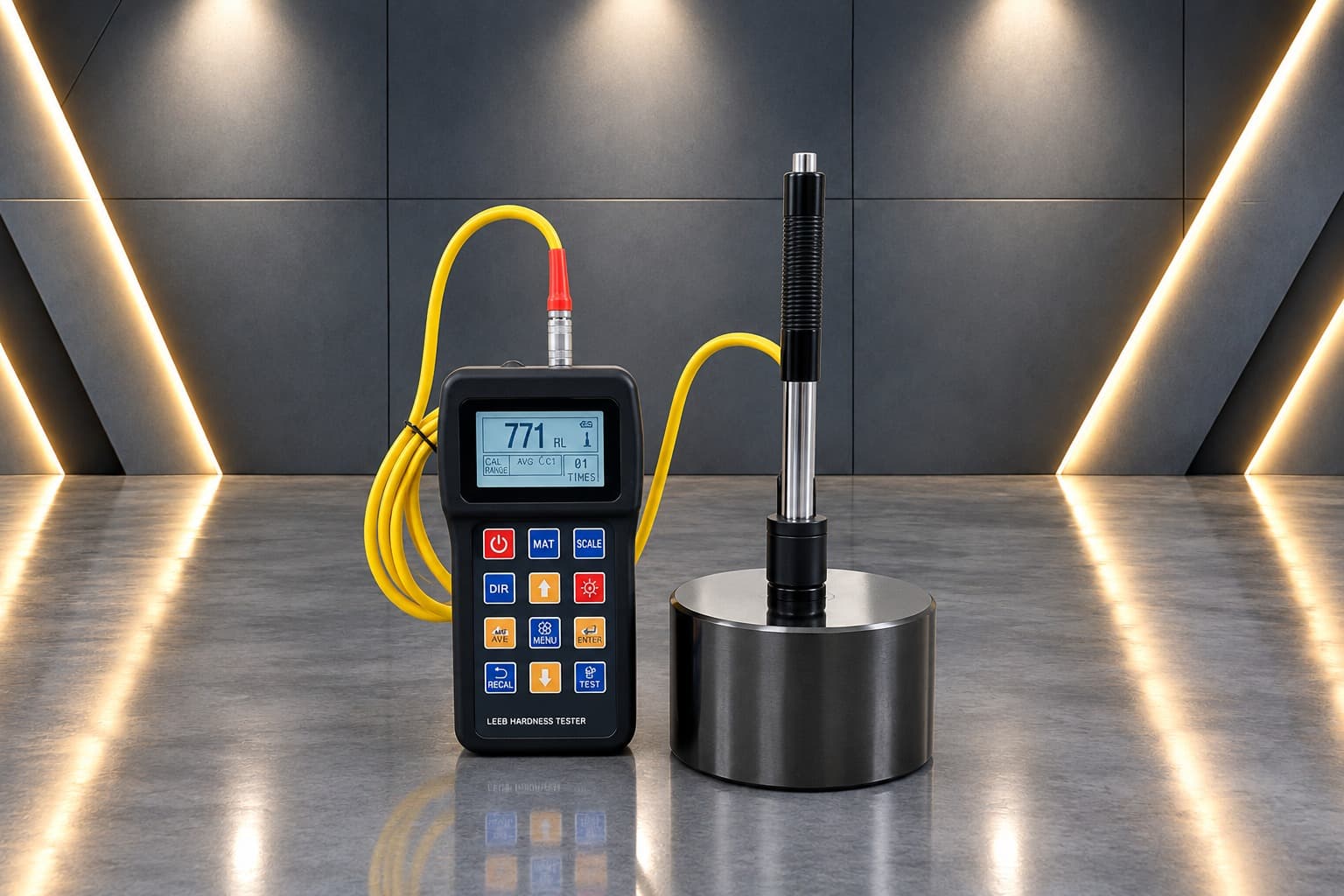
A Portable Leeb Hardness Tester in Panipat is a handheld instrument used to assess the surface hardness of metallic components through the dynamic rebound method. It measures the relationship between the impact velocity and rebound velocity of a defined impact body after it strikes the test surface. This method is particularly useful for inspecting large, heavy or installed metal components that are difficult to transport to a conventional laboratory hardness testing machine.
Civil Testing Equipment supplies hardness testing equipment for industrial inspection, manufacturing quality control, engineering workshops and maintenance applications. Depending on the selected model, measurements may be displayed in Leeb hardness (HL) or converted into scales such as Rockwell (HRC/HRB), Brinell (HB) and Vickers (HV), where supported.
A Portable Leeb Hardness Tester in Panipat helps inspectors assess hardness variations in steel components, castings, forgings and other suitable metals. Reliable results depend on material compatibility, surface preparation, component mass and thickness, impact device selection and correct testing technique.
Portable Leeb Hardness Tester Manufacturer in Panipat
When evaluating a Portable Leeb Hardness Tester Manufacturer in Panipat, buyers should consider the instrument's impact mechanism, supported hardness scales, available probes and measurement verification requirements. Civil Testing Equipment can assist with product enquiries and equipment selection according to the intended application. Specific manufacturing capabilities should be confirmed before procurement.
Working Principle and Technical Construction
The Leeb method uses a spring-loaded impact body fitted with a hard indenter. When released against a prepared metal surface, the impact body loses part of its kinetic energy during contact. The instrument measures the impact and rebound velocities, typically using an electromagnetic induction system, and calculates the Leeb hardness value.
The principal components include:
-
Impact device: Contains the spring mechanism, impact body and indenter.
-
Indenter: Commonly uses a tungsten carbide ball; other materials and configurations are available for specific applications.
-
Velocity measurement system: Detects the impact body's movement before and after contact.
-
Electronic processing unit: Calculates and displays the hardness result.
-
Support ring: Helps position the impact device against the test surface.
-
Display and data storage: Presents results and may store readings for inspection records, depending on the model.
Portable Leeb Hardness Tester Supplier in Panipat
As a Portable Leeb Hardness Tester Supplier in Panipat, Civil Testing Equipment can discuss equipment requirements for metalworking units, foundries, fabrication companies, inspection laboratories and maintenance departments.
Before selecting a model, buyers should identify the material being tested, the expected hardness range, component geometry and accessibility of the measurement location. A standard D-type impact device is commonly used for general metallic applications, while other impact devices may be better suited to narrow spaces, thin sections or particular material conditions.
A Portable Leeb Hardness Tester Supplier in Panipat should help buyers compare compatible impact devices, supported hardness scales, reference test blocks and data-handling features. Model availability, accessories and delivery schedules should be confirmed before ordering.
Technical Specifications of Portable Leeb Hardness Testers
The following table lists parameters to evaluate when comparing models. Exact values must be confirmed against the selected instrument's datasheet.
| Parameter | Technical consideration |
|---|---|
| Measurement principle | Dynamic Leeb rebound method |
| Impact device | D, DC, DL, C, G, E or other supported type |
| Primary hardness scale | Leeb hardness (HL) |
| Converted scales | HB, HRC, HRB, HV or HS, where supported |
| Compatible materials | Suitable metals within the model's specified range |
| Indenter | Type and material depend on the impact device |
| Impact direction | Vertical, horizontal or other orientations according to model capability and correction features |
| Display | Digital display with model-dependent measurement functions |
| Data storage | Internal memory or external transfer where available |
| Verification | Compatible reference hardness test block and manufacturer procedure |
| Power supply | Battery or other model-specific power arrangement |
| Standards | ASTM A956 and ISO 16859, as applicable to the instrument and testing procedure |
Features of Portable Leeb Hardness Testers
A Portable Leeb Hardness Tester in Panipat should be selected according to the component, testing environment and required inspection method. Depending on the configuration, useful features include:
-
Portable testing for large and installed components.
-
Rapid hardness readings using the rebound principle.
-
Multiple impact device options for different geometries.
-
Leeb hardness measurement with supported scale conversions.
-
Digital display for convenient result interpretation.
-
Measurement memory for recording inspection results, where available.
-
Reference-block verification to check instrument performance.
-
Different impact orientations where the instrument supports them.
-
Data-transfer or reporting functions on compatible models.
-
Optional support rings and accessories for suitable component shapes.
Applications and Industries
Portable Leeb testing is useful when conventional stationary hardness testing is impractical and the component meets the method's requirements.
-
Steel manufacturing: Checking hardness variations in suitable steel products.
-
Foundries: Assessing suitable castings and heavy metal components.
-
Forging industries: Inspecting large forgings and machined metal parts.
-
Fabrication workshops: Checking hardness during manufacturing and quality inspection.
-
Heavy engineering: Testing accessible surfaces on large machinery components.
-
Industrial maintenance: Assessing selected metallic components during inspection and repair.
-
Quality control laboratories: Performing comparative hardness checks using an appropriate procedure.
Portable Leeb Hardness Tester Distributor in Panipat
A Portable Leeb Hardness Tester Distributor in Panipat should help buyers select an impact device that matches the material and geometry of the test piece. Civil Testing Equipment can discuss instrument requirements, compatible probes and suitable accessories.
Correct specimen preparation is essential. The surface should be clean, sufficiently smooth and free from loose scale or contamination. The test piece must have adequate thickness and mass, and it must be properly supported to prevent movement during impact. Thin or lightweight components may require special preparation or a different testing method.
Portable Leeb Hardness Tester Exporter in Panipat
For buyers searching for a Portable Leeb Hardness Tester Exporter in Panipat, international supply arrangements should be confirmed before placing an order. Packaging, shipping options, product documentation and export paperwork depend on the specific order and destination.
Where applicable, confirm the commercial invoice, packing list, technical datasheet, warranty terms and destination-specific import requirements. Export destinations and shipping capabilities should be verified directly with the supplier.
Standards, Quality Checks and Measurement Verification
ASTM A956 covers Leeb hardness testing for steel products, while the ISO 16859 series addresses the Leeb hardness test method for metallic materials. The applicable standard should be selected according to the material, inspection specification and contractual requirements.
Before testing, inspect the impact device and support ring for wear or contamination. Verify instrument performance using a suitable reference hardness block according to the manufacturer's procedure. Take measurements at appropriate locations and follow the specified spacing between impact points.
Leeb testing is a surface hardness method. Readings can be affected by surface roughness, component mass, thickness, curvature, support conditions and material properties. Converted hardness values are estimates based on supported conversion relationships; they should not automatically be treated as equivalent to direct measurements using another hardness method.
How to Select the Right Portable Leeb Hardness Tester
Before procurement, consider:
-
Material type and expected hardness range.
-
Component dimensions, mass and surface curvature.
-
Accessibility of the measurement location.
-
Required impact device and indenter configuration.
-
Supported hardness scales and conversion requirements.
-
Applicable testing standard and verification procedure.
-
Data storage, reporting and accessory requirements.
These checks help ensure that the selected instrument is appropriate for the component and the intended quality-control task.
Get a Quote for Portable Leeb Hardness Tester
Contact Civil Testing Equipment to discuss your testing requirements and request a quotation. Share the material type, component dimensions, expected hardness range, preferred impact device, required hardness scales, quantity and delivery location. A technical specification or inspection procedure will help clarify the required configuration.
Phone: +91-8826549585
Email: civiltestingequipment@gmail.com
Frequently Asked Questions
1. What is a Portable Leeb Hardness Tester used for?
It assesses the surface hardness of suitable metallic components using the dynamic rebound method, particularly where large components cannot easily be moved to a laboratory.
2. What is the difference between HL and HRC?
HL is the Leeb rebound hardness value calculated from impact and rebound velocities. HRC is the Rockwell C hardness scale. Conversion is model- and material-dependent.
3. Which impact device should I choose?
The choice depends on component geometry, material, hardness range and access. D-type devices are commonly used for general applications, while specialised types address particular testing conditions.
4. Does the test require a prepared surface?
Yes. The surface must meet the method's requirements for cleanliness and finish, and the component must be adequately supported to obtain reliable readings.
5. Which standards apply to Leeb hardness testing?
ASTM A956 and ISO 16859 are relevant standards for Leeb hardness testing of metallic materials. Confirm the applicable edition and requirements for the specific inspection.