LEE CHATLER FLASK in Roorkee
Get In Touch
Lee Chatler Flask Manufacturer & Supplier in Roorkee
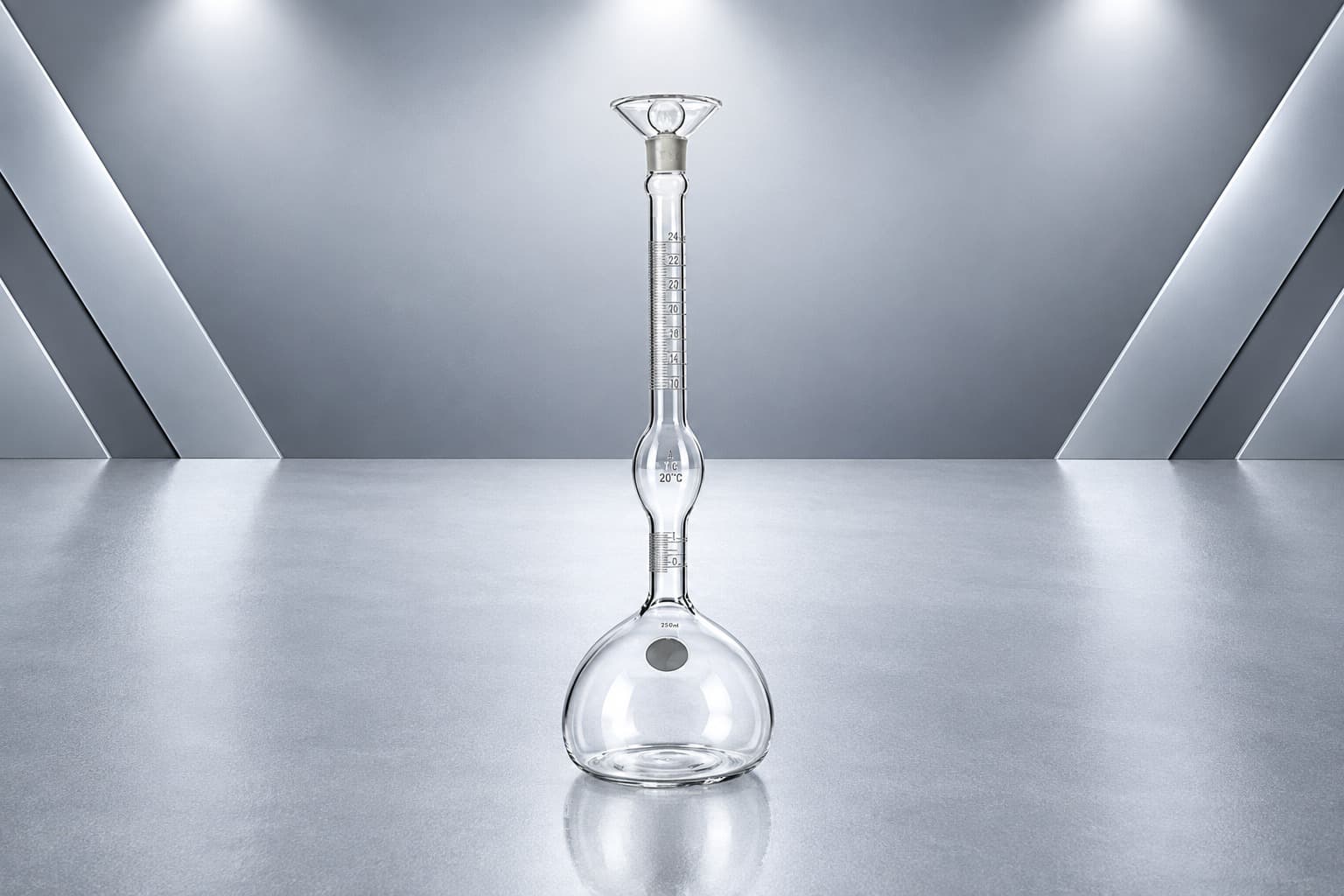
Lee Chatler Flask in Roorkee is a precision laboratory glassware instrument used for determining the density or relative density (specific gravity) of hydraulic cement and other suitable fine powdered materials. The product is commonly known in technical literature as the Le Chatelier Flask and works on the liquid-displacement principle, where the volume displaced by a measured quantity of material is determined from the calibrated neck of the flask. ASTM C188 covers the determination of hydraulic-cement density using a Le Chatelier flask.
A typical Lee Chatler Flask in Roorkee has a nominal capacity of approximately 250 mL, a bulb-shaped lower chamber, a narrow calibrated neck and a ground-glass stopper. The neck commonly incorporates graduations from 0 to 1 mL and from 18 to 24 mL, with 0.1 mL divisions on laboratory models designed for precision measurement.
For laboratories looking for a Lee Chatler Flask Manufacturer in Roorkee, selection should focus on glass quality, dimensional accuracy, graduation uniformity, stopper fit, capacity and compliance with the applicable testing procedure. The equipment is used by cement laboratories, construction-material testing facilities, R&D departments, educational institutions and quality-control laboratories.
Lee Chatler Flask Manufacturer in Roorkee
A Lee Chatler Flask Manufacturer in Roorkee should produce the flask with suitable laboratory-grade glass capable of providing transparency, dimensional stability and resistance to the liquids used during density determination. ASTM C188 specifies requirements concerning the flask's glass construction, annealing, graduation and identification.
The manufacturing process involves forming the bulb and neck from laboratory glass, creating the calibrated graduated sections, finishing the opening for the stopper and annealing the glass to reduce internal stresses. The ground-glass stopper must provide a suitable fit without compromising the flask's measurement characteristics.
Typical laboratory configurations use borosilicate glass. Indian laboratory-equipment references commonly specify a 250 mL approximate bulb capacity, approximately 243 mm overall height and a graduated neck with 0–1 mL and 18–24 mL ranges.
Dimensional inspection, graduation verification, visual inspection and stopper-fit checks should be performed before the apparatus is supplied.
Lee Chatler Flask Supplier in Roorkee
A Lee Chatler Flask Supplier in Roorkee can supply the flask for routine cement-density testing, laboratory installations, replacement requirements and educational applications. Buyers can specify the required standard, quantity, glass construction, calibration requirements and documentation before ordering.
For bulk laboratory procurement, a Lee Chatler Flask Supplier in Roorkee should be able to provide consistent units with matching capacity, graduation arrangement and stopper configuration. Where calibration documentation is required, this should be clearly included in the purchase specification.
Lee Chatler Flask Exporter in Roorkee
A Lee Chatler Flask Exporter in Roorkee can supply laboratory glassware for international testing laboratories and project requirements according to the purchaser's technical specification. Export packaging should protect the glass flask from impact, vibration and handling damage during transportation.
Depending on the purchase order, export documentation may include product specifications, packing details, commercial documentation and calibration or inspection records where applicable. International buyers should confirm the required standard and documentation before dispatch.
Lee Chatler Flask Specifications
The exact configuration should be confirmed against the applicable standard and laboratory procedure.
| Parameter | Specification |
|---|---|
| Product | Lee Chatler / Le Chatelier Flask |
| Primary Application | Density and relative-density testing |
| Main Material | Laboratory glass / borosilicate glass |
| Approx. Capacity | 250 mL |
| Lower Neck Graduation | 0–1 mL |
| Upper Neck Graduation | 18–24 mL |
| Graduation Interval | 0.1 mL on precision models |
| Intermediate Bulb | Approx. 17 mL |
| Stopper | Ground glass |
| Typical Overall Height | Approx. 243 mm |
| Typical Bulb Diameter | Approx. 90 mm |
| Standard References | ASTM C188, EN 196-6; other standards where specified |
Commercial laboratory models confirm the 250 mL capacity and dual graduated sections, while some products are supplied with calibration certificates.
Features of Lee Chatler Flask
A properly manufactured Lee Chatler Flask in Roorkee can provide:
- Precision graduated neck for liquid-volume measurement
- Approximately 250 mL laboratory capacity
- Transparent laboratory glass construction
- Ground-glass stopper
- 0–1 mL lower graduation range
- 18–24 mL upper graduation range
- Fine graduation intervals for volume readings
- Bulb-and-neck design for liquid-displacement testing
- Suitable dimensional consistency for laboratory work
- Easy visual observation of liquid level
- Compact laboratory form
- Compatibility with hydraulic-cement density testing
The flask's calibrated neck is particularly important because density determination depends on accurately observing the change in liquid volume after the test material is introduced.
Applications of Lee Chatler Flask
The principal application is determining the density or relative density of hydraulic cement. ASTM C188 identifies the test as useful in connection with the design and control of concrete mixtures.
A Lee Chatler Flask in Roorkee can be used in:
- Cement testing laboratories
- Construction-material laboratories
- Concrete quality-control laboratories
- Cement manufacturing facilities
- Civil engineering laboratories
- R&D laboratories
- Universities and engineering colleges
- Building-material testing facilities
- Laboratories testing suitable lime and fine powdered materials
Depending on the applicable standard and material, Le Chatelier flasks are also used for suitable lime, fly ash, ground granulated blast-furnace slag and other fine materials.
Industries We Serve
The product is relevant to cement manufacturers, concrete producers, EPC contractors, infrastructure companies, construction-material laboratories, engineering consultants, testing agencies, educational institutions and research organizations.
For procurement teams, the key considerations are standard compliance, glass quality, graduation accuracy, capacity and the availability of calibration or inspection documentation.
Standards & Specifications
The principal reference for hydraulic-cement density determination is ASTM C188 – Standard Test Method for Density of Hydraulic Cement. Other laboratory product specifications may reference EN 196-6 and AASHTO T133, depending on the intended application.
Indian laboratory suppliers also commonly list IS 4031 alongside ASTM C188 for cement-testing applications. Buyers should confirm the latest applicable edition and the exact requirements of their laboratory or project specification before ordering.
Quality Standards & Testing of Lee Chatler Flask
Quality control can include:
- Visual inspection of the glass
- Capacity verification
- Graduation inspection
- Neck-dimension inspection
- Bulb-dimension verification
- Stopper-fit inspection
- Leakage checks
- Surface and workmanship inspection
- Calibration verification where required
- Identification and traceability checks
ASTM C188 specifies requirements related to glass quality, annealing, graduation and identification of the flask.
How to Select the Right Lee Chatler Flask
Before purchasing, buyers should evaluate:
- Application – Confirm whether the flask is required for hydraulic-cement density or another fine-material application.
- Applicable standard – Specify ASTM C188, EN 196-6, IS requirements or another applicable procedure.
- Capacity – Confirm the required approximately 250 mL configuration.
- Graduation – Check the required 0–1 mL and 18–24 mL graduated sections.
- Glass quality – Laboratory-grade glass should provide suitable transparency and dimensional stability.
- Stopper – Confirm the ground-glass stopper and proper fit.
- Calibration – Request calibration documentation if required by the laboratory quality system.
- Quantity – Bulk requirements should specify consistent dimensions and graduation characteristics.
Why Choose a Lee Chatler Flask Manufacturer in Roorkee?
When selecting a Lee Chatler Flask Manufacturer in Roorkee, buyers should evaluate the manufacturer's ability to maintain consistent glass dimensions, calibrated graduations, stopper fit and product quality. Technical documentation should clearly identify capacity, material, graduation ranges and applicable standards.
For laboratory projects, institutional procurement and bulk orders, specifications should be finalized before quotation so that the supplied flask matches the testing procedure.
Lee Chatler Flask Supply for Industrial Projects
A Lee Chatler Flask Supplier in Roorkee can support new laboratory installations, replacement requirements, educational laboratories and expansion projects. The equipment can be procured individually or as part of a broader cement and concrete testing laboratory requirement.
For international requirements, a Lee Chatler Flask Exporter in Roorkee can coordinate packaging and shipment according to the destination and purchase-order requirements. Buyers should provide the required quantity, standard, calibration requirements and delivery location when requesting a commercial offer.
Get a Quote for Lee Chatler Flask
To obtain an accurate quotation, provide:
- Product name
- Required standard
- Quantity
- Capacity
- Glass/material requirement
- Graduation requirement
- Calibration requirement
- Inspection/documentation needs
- Delivery location
A Lee Chatler Flask Distributor in Roorkee can use these details to prepare the appropriate commercial quotation for laboratory procurement. For bulk orders, institutional purchases or project requirements, sharing the technical specification with the enquiry can help avoid configuration differences.